
The geometry of power, the weight of witness
On the Iran–Israel–US Conflict and the Silence that Remains
Demetris Vohaitis – Toronto | In the architecture of international relations, where states exist as abstractions with defined interests and boundaries, war is rarely personal. It is cartographic. It is strategic. It is, as the realists have long asserted, a language spoken fluently by power. And in the ongoing confrontation between Iran and the alliance of Israel and the United States, realism is not merely an analytical frame — it is the very terrain.
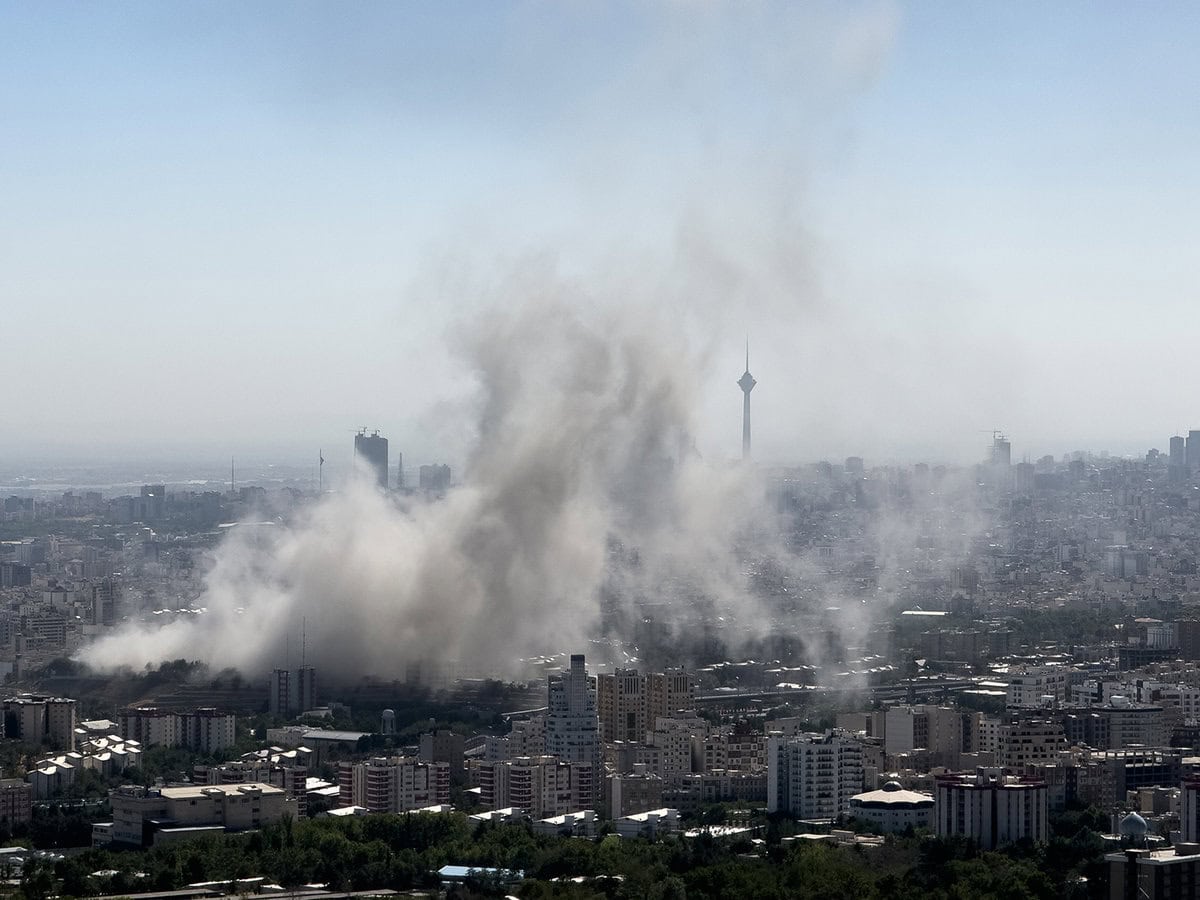
Here, there is no pretence of morality. What unfolds is the choreography of survival, the escalation of force to deter force, a political geometry in which security is defined not by peace but by the capacity to inflict irreversible damage. In this lexicon, deterrence is doctrine, and retaliation, doctrine’s punctuation.
Under the renewed command of President Donald Trump, Washington no longer pretends to cloak its power in the language of principle. It speaks in the raw idiom of coercion, sanctions as siegecraft, alliances as transaction, and deterrence as spectacle. In this framework, diplomacy is not dialogue but delay, a prelude to force. Israel, under the rigid calculus of Prime Minister Benjamin Netanyahu, approaches Iran not merely as a threat, but as a theological aberration to be neutralized, a nuclear ghost conjured for political survival and regional supremacy.
It navigates the region with tactical precision but moral indifference, collapsing history into binary equations of security and annihilation. And Iran, governed by a regime that speaks in the voice of revolution but rules through repression, does not merely defend itself; it performs defiance. Encircled, yes, but not innocent, Tehran responds to every provocation with the dramaturgy of vengeance, its policies forged as much by paranoia as by past wounds.
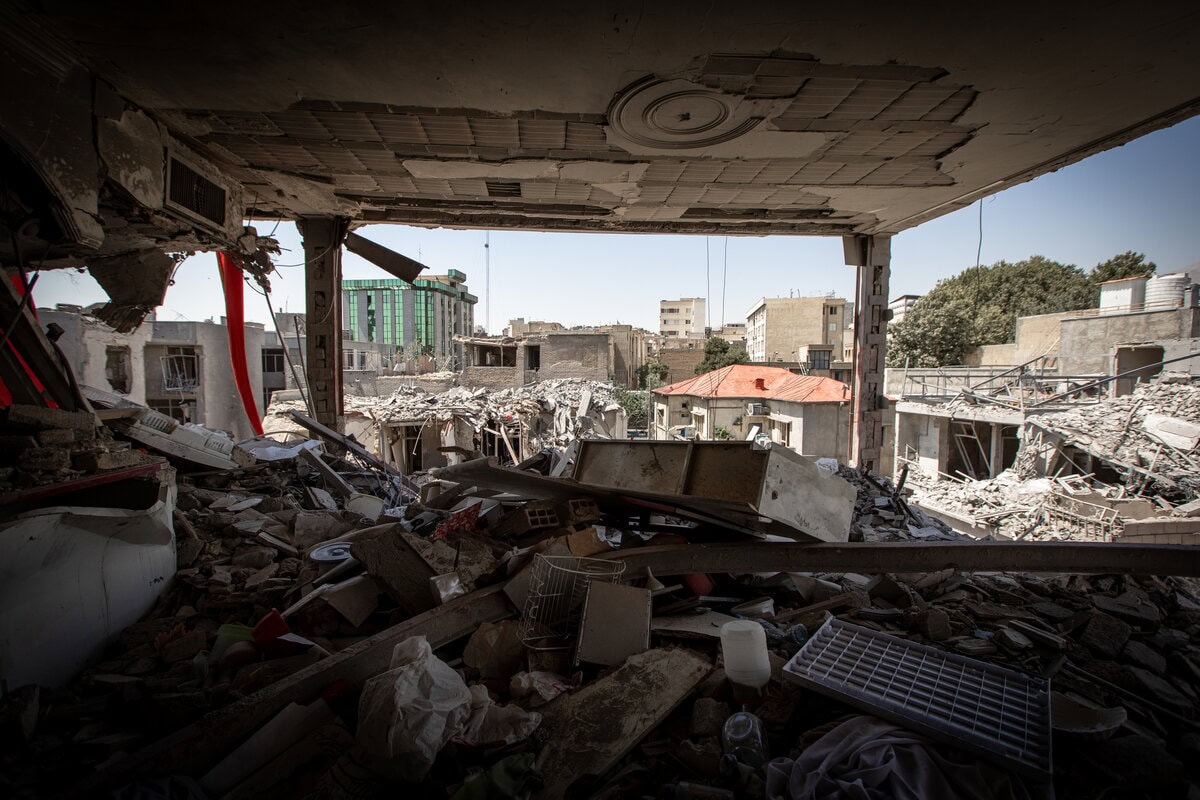
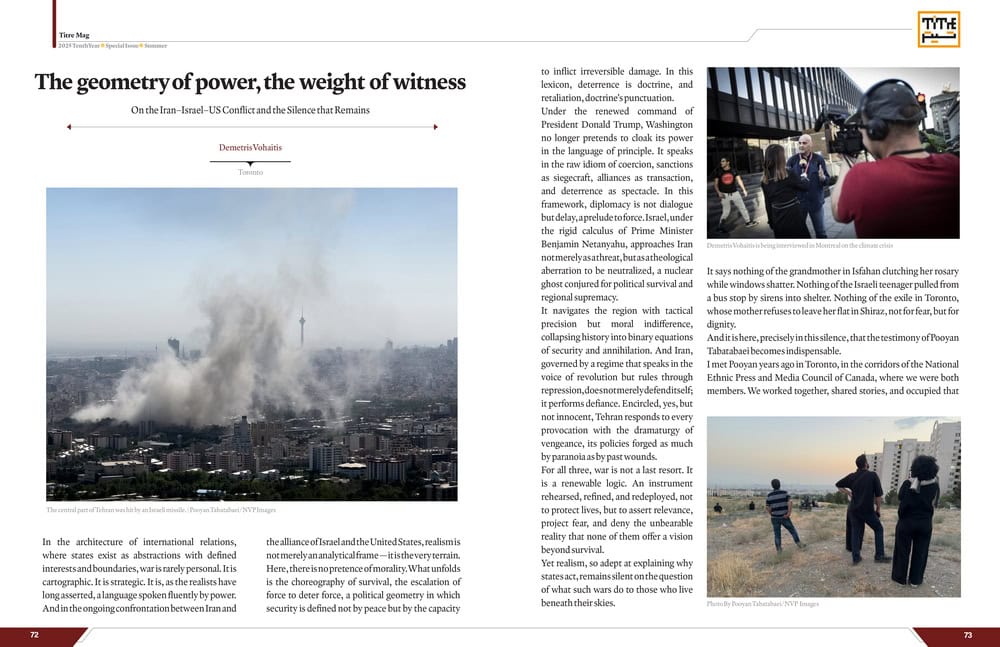
For all three, war is not a last resort. It is a renewable logic. An instrument rehearsed, refined, and redeployed, not to protect lives, but to assert relevance, project fear, and deny the unbearable reality that none of them offer a vision beyond survival. Yet realism, so adept at explaining why states act, remains silent on the question of what such wars do to those who live beneath their skies.
It says nothing of the grandmother in Isfahan clutching her rosary while windows shatter. Nothing of the Israeli teenager pulled from a bus stop by sirens into shelter. Nothing of the exile in Toronto, whose mother refuses to leave her flat in Shiraz, not for fear, but for dignity. And it is here, precisely in this silence, that the testimony of Pooyan Tabatabaei becomes indispensable.
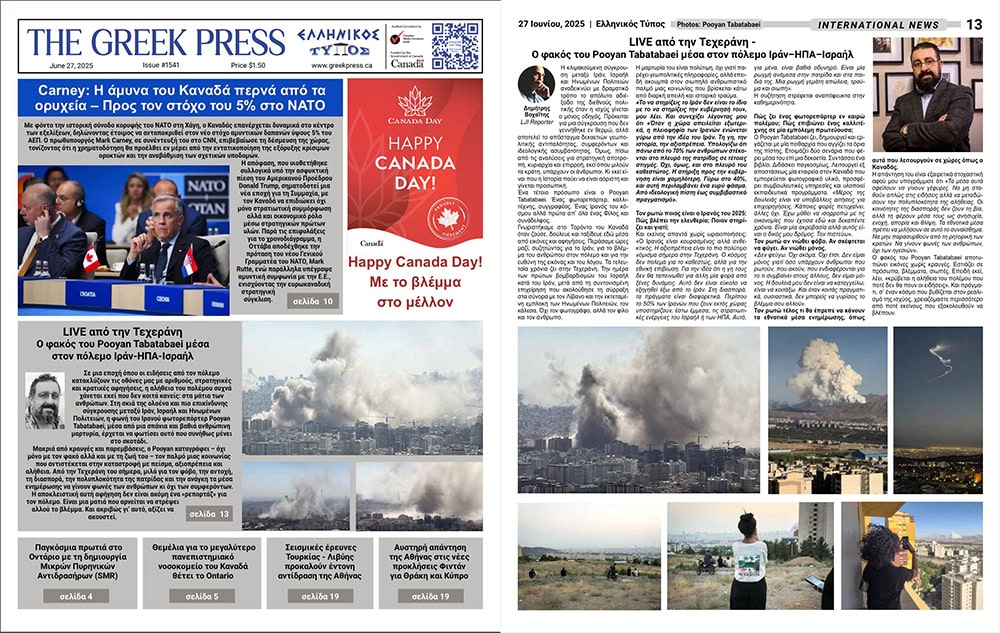
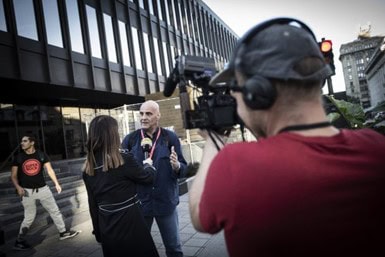
I met Pooyan years ago in Toronto, in the corridors of the National Ethnic Press and Media Council of Canada, where we were both members. We worked together, shared stories, and occupied that fragile space where journalism touches memory, and memory resists forgetting, and it was here where we spoke about the Truth that is the victim of war and human relations.
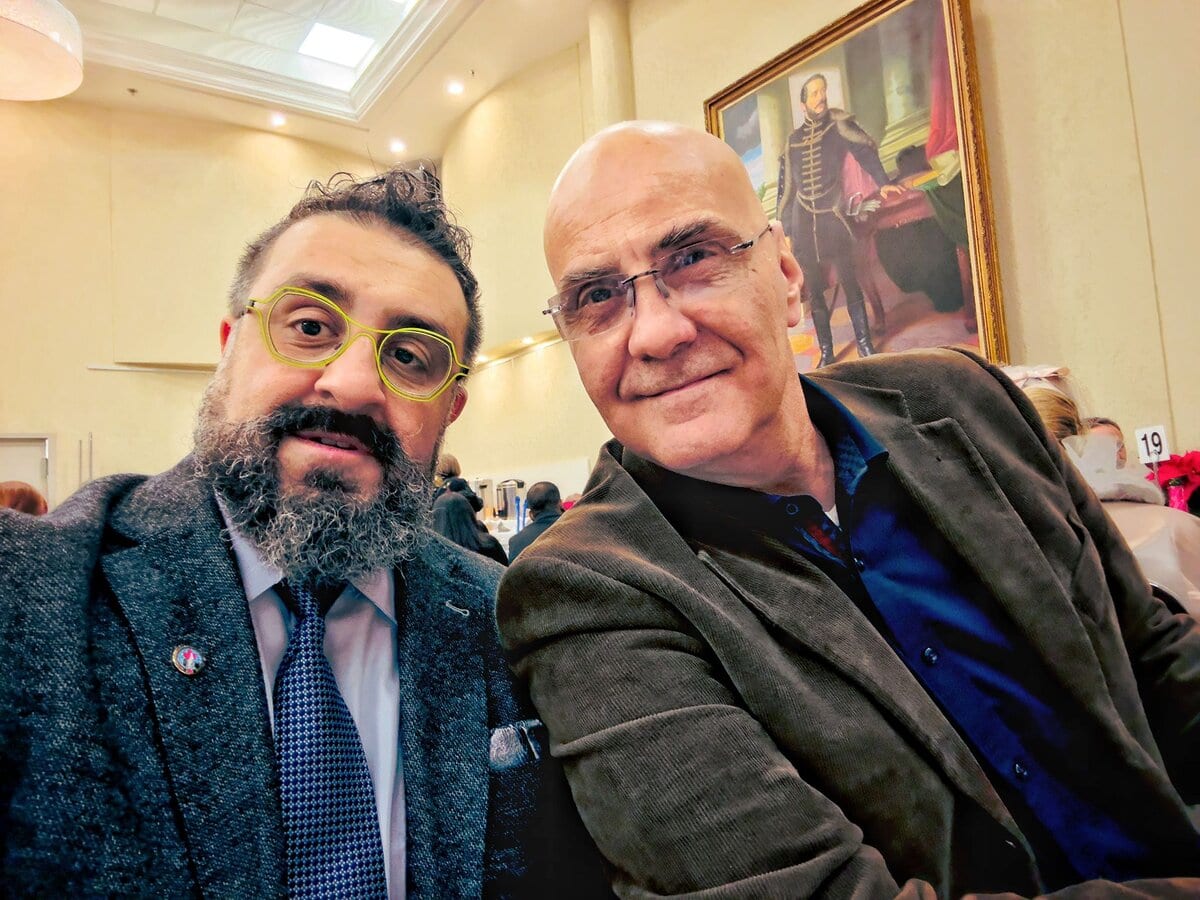
Born in Tehran, Pooyan is an award-winning visual journalist whose work defies the superficiality of spectacle. Since 1998, he has chronicled not just conflicts, in Libya, Egypt, India, Iran, but their emotional residue. The eyes of the bereaved, the fatigue of the displaced, the quiet refusal to despair.
His images have appeared in Time Magazine, Toronto Star, BBC, Panorama, and CBC. He is the founder of NVP Images, a photo agency devoted to cultural narratives and human rights. Twice honored as Journalist of the Year by Canada’s National Ethnic Press and Media Council, he is also a recipient of the Magnum Foundation Photography and Social Justice Fellowship, and a recent participant in the VII Photo Agency’s masterclass in visual storytelling.
But beyond the accolades lies something more elemental: a gaze that does not flinch. When the first Israeli airstrikes struck Iranian soil, I called him — not as a journalist, but as a friend. He had returned to Tehran, where he now lives and works. Our conversation began with a question that no outlet dares to ask aloud…
Do people in Iran support the government? Do they stand with its actions, with its very existence?
His answer was both precise and impossible.
“That’s a very complicated question, and an important one,” he said. “There’s no precise way to measure it, and the answer depends heavily on how you frame the question: standing with Iran is very different from standing with the government.”
In those words lies the existential paradox of the nation-state: the conflation of land and regime, history and authority, memory and propaganda.
“What I can say is this,” Pooyan continued. “When the country faces external threats, most people rally around the idea of Iran — its land, its history, its dignity. National pride runs deep here. With a population of over 90 million, I’d estimate that more than 70% of people, regardless of their political stance, stand with Iran in times of crisis. But support for the government itself is lower, probably around 40%, and that includes a wide spectrum of beliefs, from ideological loyalty to reluctant pragmatism.”
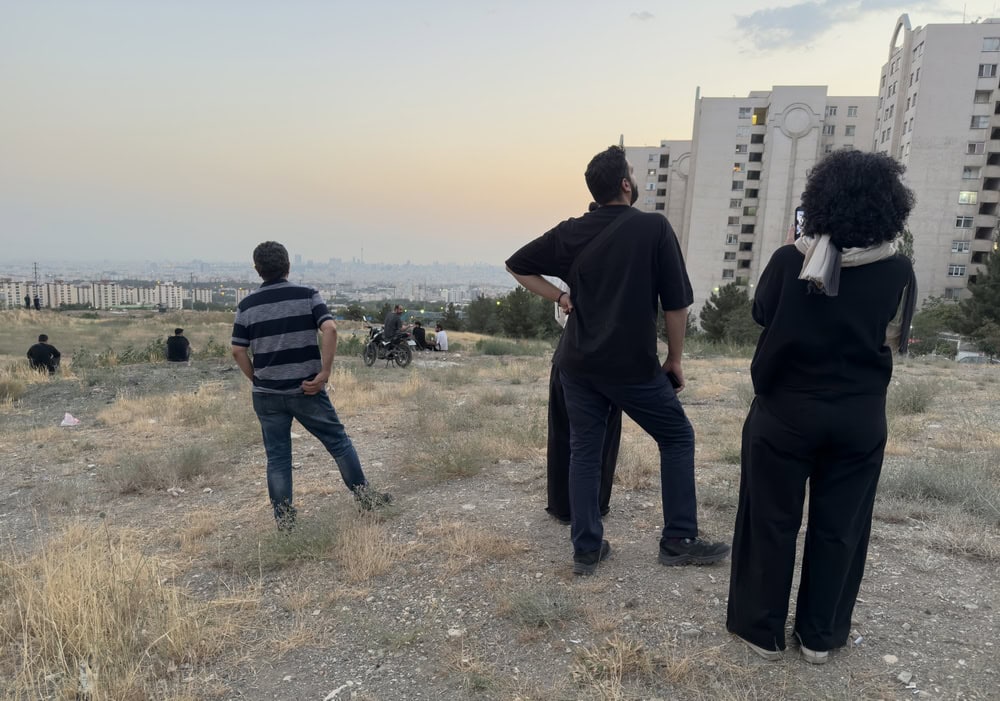
This distinction, between the homeland and those who govern it, is critical. And it reverberates even more painfully among the diaspora.
“Among the 5 million Iranians abroad, things are different. Sadly, I’d say fewer than 35% identify with Iran in the same way during moments like this. And perhaps around 50% are, in some way, supportive of Israeli or U.S. military actions, which is heartbreaking when you consider the depth of culture and history this nation holds. It’s painful to witness that fracture, but it also speaks to years of disconnect, trauma, and loss between Iran and many of its children abroad.”
To be part of a diaspora, then, is to live within a philosophical wound, a condition in which the coordinates of identity collapse into contradiction.
You love a land, but distrust its flag. You miss a people, but fear their rulers. You mourn a history, but flee its present.
And yet, even in the face of such ontological fragmentation, Pooyan continues to create. He is working on a book. He is finalizing two film scripts, one of which he hopes to bring to life within the next eighteen months. He teaches. He mentors. He leads workshops across continents.
“In terms of how I manage things financially,” he tells me, “I run a company based in Canada that sells journalistic images, offers advisory services, and runs educational programs globally. A big part of my time has been spent teaching workshops. As both a journalist and an artist, part of the work also involves applying for grants and securing funding to keep projects going.
But to be honest, like many people in the creative world, those sources don’t always cover everything. So I also rely on the savings I’ve built up over the last 15 years of hard work. It’s a bit of a balancing act, but it’s one I believe in.”
There is something almost Camusian in this ethic, a quiet rebellion against absurdity through endurance, craft, and refusal to look away.
And then, I ask him what might be the most ethically urgent question for our time.
What should ethnic media do in moments of war, exile, and existential rupture?
His answer is not tactical. It is philosophical.
“Ethnic media has an essential role to play, especially in times of crisis. Their responsibility is not just to report, but to become a bridge. They need to stay neutral and grounded, sharing information from all sides involved, so communities can see the full picture, not just fragments of it. At the same time, they have to keep the emotional pulse in mind. People living far from their homelands often experience crisis from a place of deep worry and helplessness. They’re not living the moment firsthand, but their hearts are right in it. They’re anxious for loved ones, and what they need most is reliable information, a sense of connection, and, when possible, a little comfort and hope.”
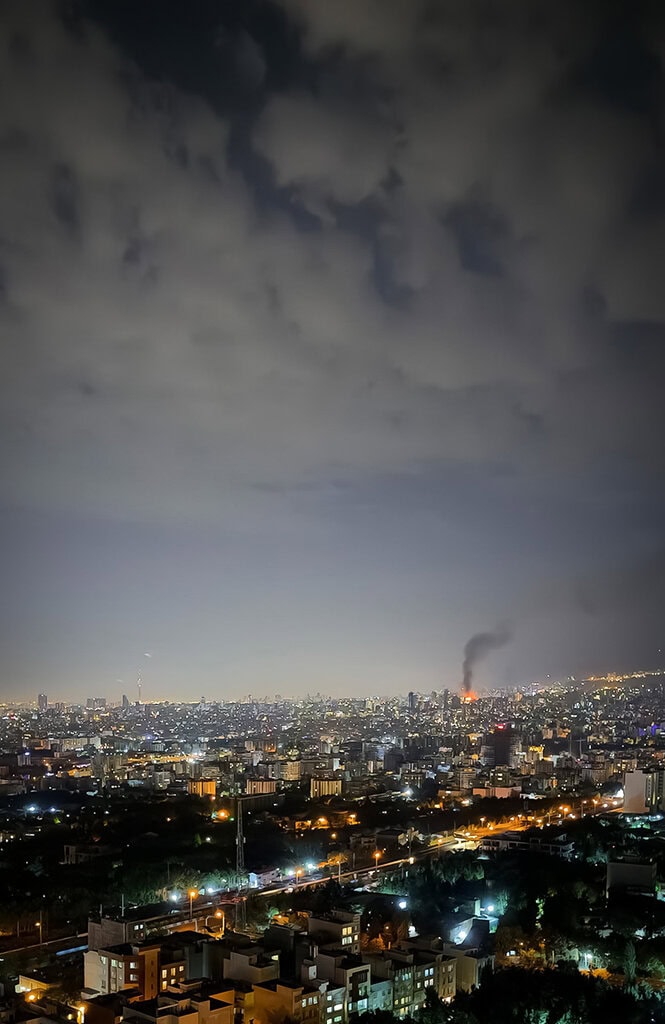
And then, as if closing a circle, he adds, “Ethnic media can offer all of that. And in doing so, they become more than news outlets; they become lifelines.”
In an age where narratives are manufactured with algorithmic speed, and silence is weaponized, Pooyan Tabatabaei’s lens reminds us of a deeper truth: that war may belong to states, but meaning belongs to people.
He does not photograph destruction. He photographs the after. The breath that follows the blast. The silence that survives the slogan. The gaze that, despite it all, remains.