
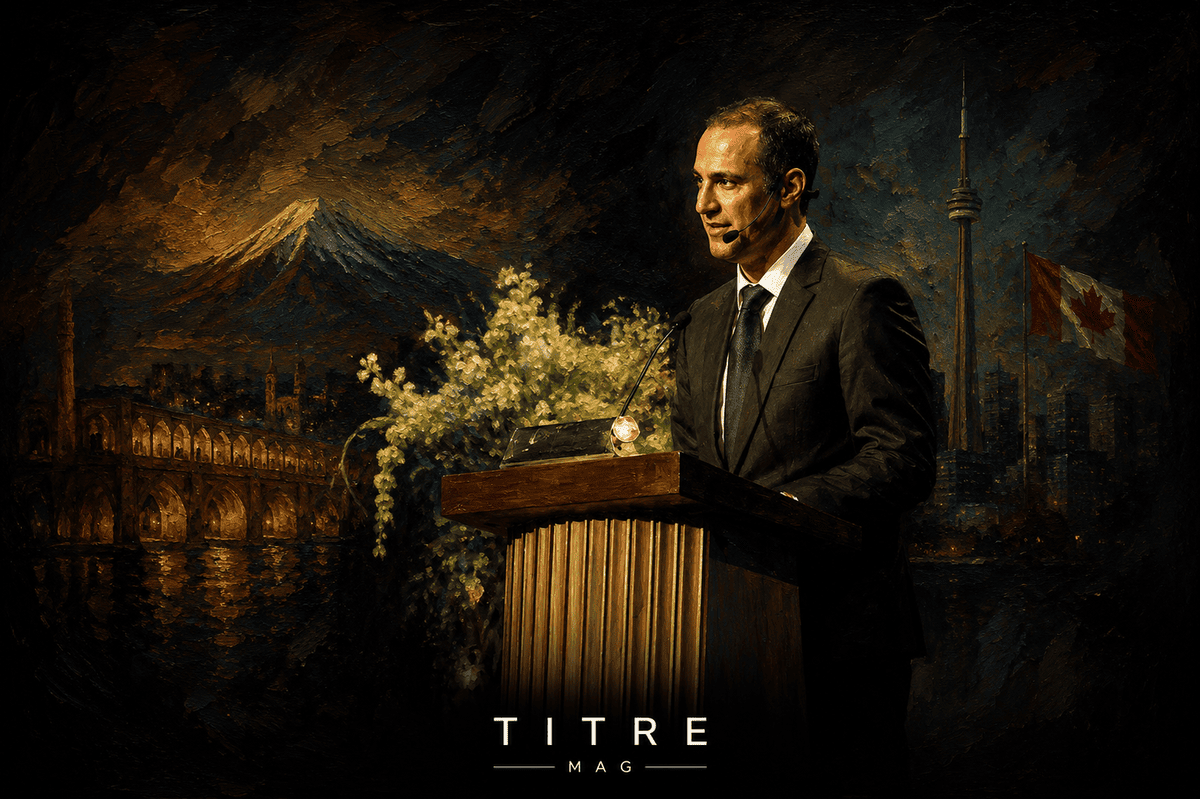
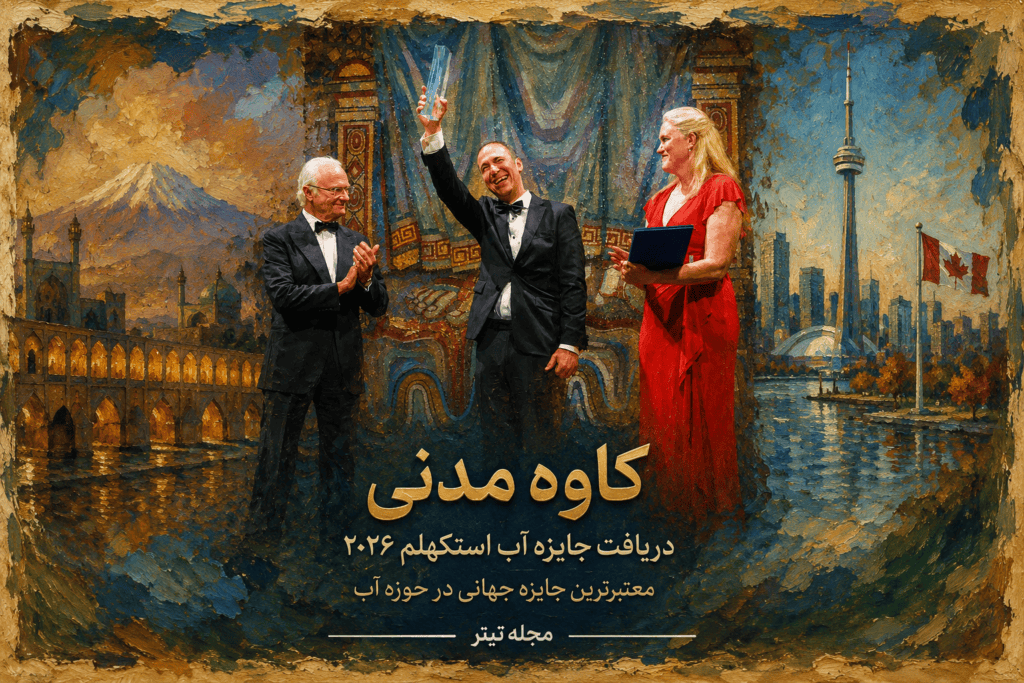
Mina Rahimi – Toronto: On August 26, 2026, Kaveh Madani stood before King Carl XVI Gustaf of Sweden in Stockholm to receive the 2026 Stockholm Water Prize. The distinctive crystal sculpture placed in his hands represents the world’s most prestigious award for achievement in water, an honour so prominent in the field that it is often described as the “Nobel Prize of Water.”
For Madani, the moment carried a personal symmetry. Years earlier, he had come to Sweden to study water resources at Lund University. Now he was back in the country where an important part of his academic journey began, this time as the recipient of the field’s most prestigious international award. After the ceremony, Madani wrote in Persian that he was leaving Sweden with “sweet and unforgettable memories,” adding that he was proud to have had the opportunity to carry the name of his beloved Iran onto a global stage.
The Stockholm ceremony was not the announcement of his win. Madani had been named the 2026 laureate on March 18 during a World Water Day ceremony at UNESCO headquarters in Paris. The formal presentation followed during World Water Week in Stockholm in August.

Despite its familiar nickname, the Stockholm Water Prize is not a Nobel Prize and is not part of the Nobel awards. Established in 1991, it recognizes individuals and organizations whose work has made exceptional contributions to the sustainable use and protection of the world’s water resources. It is awarded annually by the Stockholm Water Foundation in cooperation with the Royal Swedish Academy of Sciences. King Carl XVI Gustaf is the official patron and presents the prize during World Water Week. The award includes one million Swedish kronor and a distinctive crystal sculpture.
Its international standing has earned it the unofficial description “Nobel Prize of Water.” The United Nations University calls it the world’s most prestigious water award. Madani’s selection also made history. At 44, he became the youngest laureate in the history of the Stockholm Water Prize, as well as the first United Nations official and the first former politician to receive the honour. But the significance of his work extends beyond academic credentials or conventional research into water scarcity.
Much of Madani’s career has been devoted to changing how water crises are understood. His research challenges the tendency to view severe water problems primarily through infrastructure and physical scarcity. Governance, political decisions and the way societies manage and allocate their resources can be central to the problem. His work has helped shift the international water debate from infrastructure alone toward the governance structures behind severe water crises.
The Stockholm Water Prize committee recognized precisely that breadth, citing Madani’s combination of research in water resources management with policy, diplomacy and global engagement, pursued at times amid significant personal risk and political complexity. One concept closely associated with his work is water bankruptcy.
The idea can be understood much like a bank account. Nature provides a renewable supply of water, while groundwater and other reserves accumulated over time function like savings. When societies repeatedly consume beyond renewable supplies while depleting those reserves, they can reach a point where returning to historical water conditions is no longer realistically possible.
At that stage, describing the situation simply as a “crisis” can be misleading. A crisis implies something temporary and potentially reversible. Water bankruptcy describes a deeper structural condition in which overexploitation is accompanied by degradation of the natural systems that produce, store and regulate water. Madani developed the formal concept and authored the United Nations University’s 2026 Global Water Bankruptcy report.
Born in Tehran, Madani studied civil engineering at the University of Tabriz before completing a master’s degree in water resources at Lund University and a PhD in civil and environmental engineering at the University of California, Davis. His career later included academic positions at Imperial College London, Yale University and the City College of New York.
He also returned to Iran and served as Deputy Head of the country’s Department of Environment. That chapter proved brief and politically difficult. Madani later left Iran in 2018 after facing detention, interrogation and mounting pressure, eventually returning to international academic and policy work. His path ultimately led to Canada.

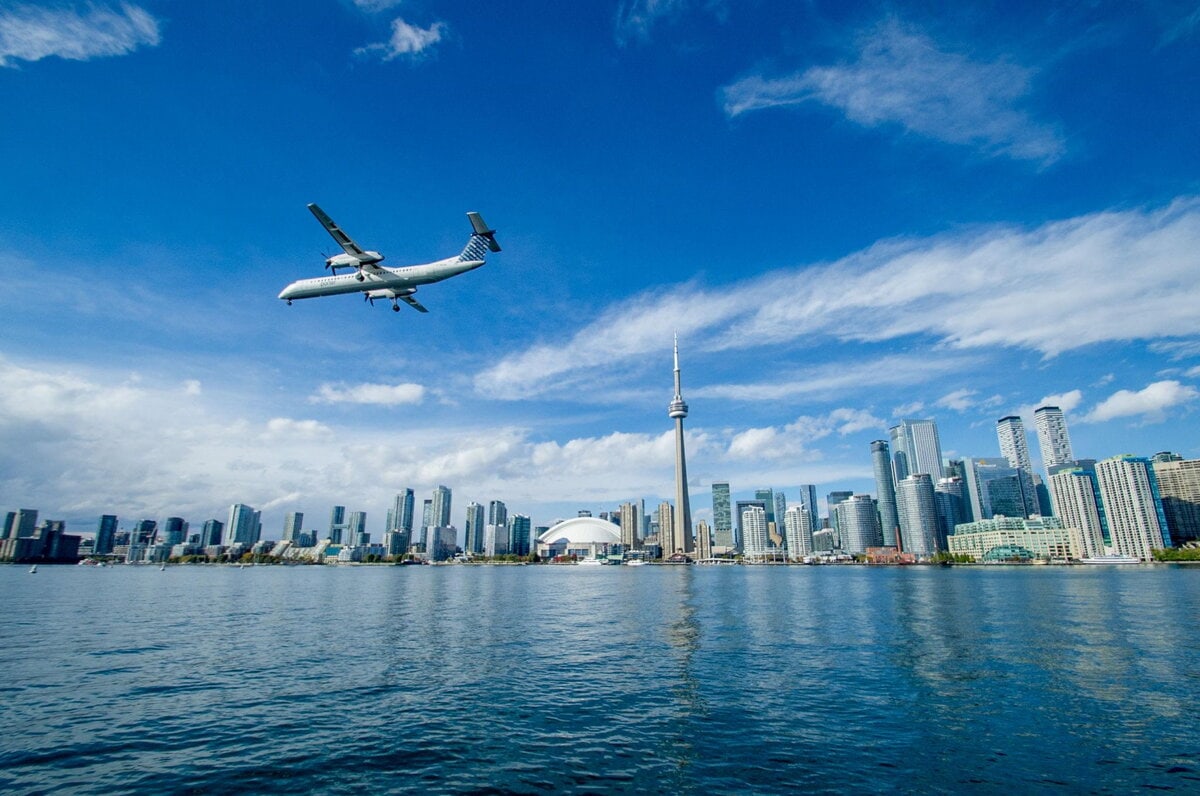
Madani now lives in Toronto and serves as Director of the United Nations University Institute for Water, Environment and Health. The institute is headquartered in Richmond Hill, Ontario, and has been hosted and supported by the Government of Canada since 1996. Known as the UN’s think tank on water, it conducts research and policy work on water, environmental and human security challenges around the world.
The Canadian connection is therefore more than a biographical footnote. From the Greater Toronto Area, Madani leads a United Nations institute working on some of the same global water challenges for which he has now received the field’s highest international recognition. Canada has also publicly recognized his achievement: its ambassador to the United Nations in Geneva congratulated Madani on the prize earlier this year, citing his interdisciplinary leadership on water and sustainability.
The ceremony in Stockholm brought several chapters of Madani’s life together. He had once arrived in Sweden as an Iranian student of water resources. He later returned to Iran and entered environmental policymaking, left the country under difficult circumstances and eventually continued his work from Canada. Years later, that journey brought him back to Sweden.
This time, he returned as the youngest laureate in the history of the Stockholm Water Prize, standing before the Swedish king with the crystal sculpture of an honour known around the world as the “Nobel Prize of Water.” And after the ceremony, Madani brought the story back to Iran. Among everything he could have said about the achievement, he chose to emphasize something personal: the privilege of carrying Iran’s name with him onto a global stage.