

Pooyan Tabatabai – Toronto – Part of Titre Mag’s TIFF 2026 coverage | I quicken my pace. The screening is about to begin, and streets I know well have been taken over by TIFF crowds. People have been lining up for hours, hoping to see the film they came for, or simply to get lucky enough to make it into one of the festival’s more sought after screenings. I finally make my way through the crowd and reach the theatre doors. A few minutes later, I am inside. Seven films connected to Iran and Iranian cinema are screening at TIFF this year, and at least five carry, directly or indirectly, the politics and social realities of contemporary Iran with them. Ghasideh Golmakani’s Head to Head is one of them.
From its opening moments, the film makes it clear that it has no intention of taking us into an entirely familiar Iran. What emerges instead is a strange world, surreal and at times absurd, where the positions of men and women have been reversed. And the reversal is not limited to clothes. Power has changed hands. Behaviour has changed. Even the way people look at and speak to one another feels slightly out of place. This sense of displacement becomes one of the foundations of the film’s world. Roles have been knocked out of their familiar positions, and then the film itself begins to move, leaving an isolated villa, climbing into a van and heading out onto the road.
Golmakani establishes the rules of this world remarkably quickly. Within minutes, seeing men dressed in clothing that, in the film’s real world, would belong to women no longer seems particularly strange. We accept the rules of this strange world, and that may be the film’s first real achievement.
For a filmmaker’s first feature, Head to Head is never dull. It has plenty of genuinely funny moments. It can make you smile and, almost simultaneously, leave you thinking about what lies beneath the joke. You can follow the film from beginning to end without fatigue, which is no small achievement for a work built around such an unconventional premise. Among these moments, Leili Farhadpour’s brief appearance is particularly memorable. Farhadpour, whose performance in My Favourite Cake remains fresh in the memory, is not given much screen time here, but she turns what little she has into something lively and funny. It is a small role, but one of those small roles that stays with you after the film is over.
And yet this is precisely where the film’s central contradiction begins to reveal itself. The problem begins when the film stops trusting its own images. Again and again, a visual idea that has already landed is explained a second time through dialogue. Women’s freedom, compulsory hijab, prison, resistance and other familiar political themes enter the conversations explicitly.
My problem is not that the film is political. It is political from the outset, and there is no reason it should pretend otherwise. The problem is that too many of these lines are overly explicit, sometimes even heavy handed, and add very little to what the images have already made clear. The film has already found a far more effective way to say these things.
Men being forced, even temporarily, to experience restrictions that women have lived under for more than four decades is itself a powerful political image. A man who initially refuses to submit to that imposition, then gradually finds himself confronting an experience that had previously belonged to someone else, makes the point without requiring a speech about women’s freedom. Why explain it all over again?
One could even argue that without many of these lines, Head to Head might have been a more daring political film. Rather than dictating the meaning of its images, it could have left viewers inside this strange world and trusted them to experience and interpret it for themselves.
Even the Persian title plays a clever game with the world the film has created. Sar be Sar does not quite mean the same thing as the literal English title, Head to Head. In Persian, sar be sar e kasi gozashtan means to tease someone, toy with them, or keep them slightly off balance for amusement. In that sense, the Persian title may actually describe the film more precisely than the English one. Perhaps that is what the film itself has been doing to us from the beginning. It places a familiar world in front of us, shifts everything slightly out of position, and waits to see how long it takes us to notice the game.

The same ambiguity extends to the characters. Golmakani assembles a group of very different people and gives each of them a function within this world, but what develops is closer to an atmosphere built around characters than character development in the conventional sense. We know relatively little about any of them. They enter the story from somewhere beyond our knowledge. We do not know their full histories, and when the film ends, we do not necessarily know exactly who they were or what will happen to them after this journey. As long as the film remains within its surreal and absurd universe, this is not a weakness at all. In fact, part of the appeal of these characters lies precisely in how much of them remains unknown.
Another way to think about the film’s structure is as a train journey. We board at a station after the train has already begun its journey. Later, we get off at another station before it reaches its final destination. We have seen neither the complete beginning of the story nor its ending. For a brief stretch of time, we have simply travelled alongside people whose lives were already in motion before we arrived and will continue after we leave.
There is something here that recalls the dramatic world of Harold Pinter, where characters often enter without fully explained pasts and pass before us without every question being answered. Head to Head attempts something similar in parts of its narrative. We enter the story after it has already begun moving and leave before everything has been resolved. How consistently this approach works across the film is debatable, but Golmakani gets enough of it right that the absence of detailed backstories and tidy futures does not, in itself, feel like a flaw.
The trouble begins when the film decides to explain these same characters through direct political dialogue. Suddenly, a person who moments earlier belonged to an intriguing and unknowable world becomes the carrier of a specific message. At these moments, the characters in Head to Head remind me of balloons. The film has allowed them to rise and float inside its strange sky, but whenever one of these explanatory conversations begins, a string catches hold of them and pulls them back toward the ground. And as they come back down to earth, some of their magic disappears with them.

A Road We Have Travelled Before
Once the characters leave the villa, climb into the van and begin travelling, Head to Head enters another territory familiar to followers of contemporary independent Iranian cinema: a handful of people, a vehicle, a long road, and a country passing by through the windows.
We have seen versions of this image repeatedly in recent years. Panah Panahi’s Hit the Road built its world around a family travelling across Iran in 2021. Ali Zarnegar’s Cause of Death: Unknown placed seven strangers together on a road journey in 2023. In Jafar Panahi’s It Was Just an Accident in 2025, the van, the road and a group of people once again became central to the narrative. Now, in 2026, Head to Head takes part of its own world onto that same road. The connection is not merely conceptual. Amin Jafari is the cinematographer of Hit the Road, It Was Just an Accident and Head to Head. Cause of Death: Unknown has a different cinematographer, but formally, as a road film, it belongs in the same conversation. Is this repetition necessarily a problem? No.
Perhaps the vehicle and the road are becoming part of the vocabulary of contemporary independent Iranian cinema: a space suspended between origin and destination, occupied by people who no longer entirely belong to where they have come from but have not yet reached wherever they are going. Seen this way, the van becomes more than a location. Different people are confined together in a small space and forced to keep moving while a changing country passes beyond their windows. The destination may be unclear, but the movement continues.
For the cinema of a country that has spent years negotiating political, social and generational upheaval, the image carries considerable weight: Iran as a long, complicated journey whose destination remains unknown. The question for Head to Head, then, is not why there is another van or another road. It is what Golmakani does with this familiar cinematic language that is new.
Perhaps the answer lies once again in displacement. Here, people are not simply moving through geography. Social roles have also been displaced. Men and women have traded positions. Power relations have been inverted. The passengers are travelling through a world whose rules themselves have been knocked out of their familiar places. In this reading, the road becomes an extension of the film’s original act of displacement. Everything is moving: places, people, roles and rules.
When the Frame Speaks
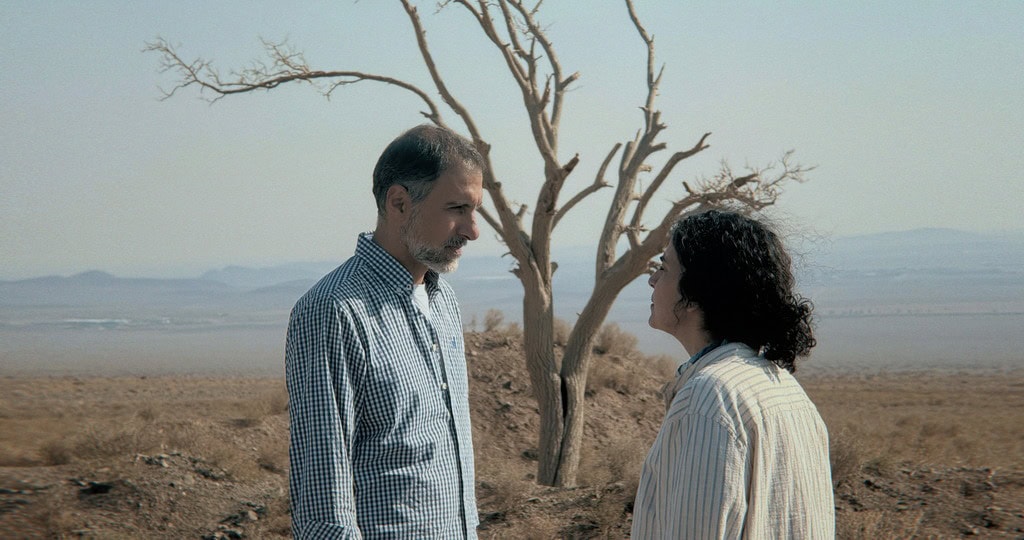
For me, much of the film’s strength lies in its images. The cinematography is strong in many sequences, but some of the film’s most striking images arrive when the camera stops moving and simply allows the frame to hold.
Beyond their visual beauty, some of these static compositions carry something that may feel familiar to viewers acquainted with the history of photography, particularly the tradition of documentary photography. The arrangement of people within the frame, the distances between bodies, the negative space surrounding them, and the relationship between the human figure and the environment activate a kind of visual memory. At times, it feels as though relationships between people and circumstance that we have encountered in important documentary photographs are being rediscovered here in moving images.
I do not mean that the film is necessarily referencing a particular photograph or photographer. It feels more like borrowing from a shared visual memory. For viewers familiar with that layer of photographic history, certain shots carry an additional sense of recognition. They evoke photographs that have captured larger human and social realities within a single image. And interestingly, these are precisely the moments when the film needs no explanation whatsoever. The frame speaks for itself.
Colours for a Muted World
I watched the film with Sasan Bagherpour Asvandi, a prominent sound engineer in Iranian cinema, and after the screening we had an opportunity to talk about it. Some of Sasan’s observations overlapped with mine, particularly regarding the strength of the film’s surreal atmosphere and the damage done to it by dialogue that becomes too direct or slogan like. But he also raised several other points worth considering, beginning with the film’s colour design.
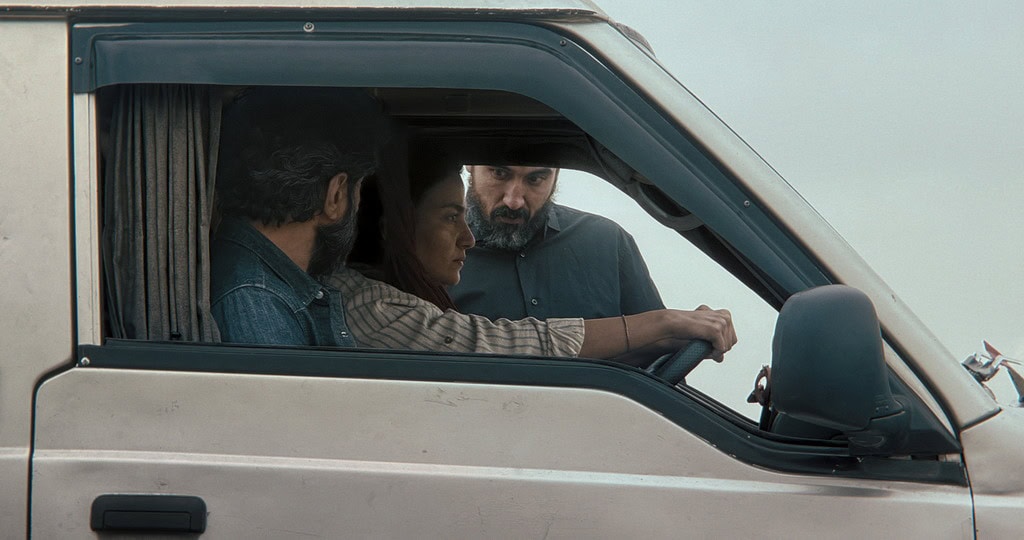
Head to Head does not create a polished, pristine world. Its colours are muted, earthy and occasionally drained of life. This is particularly noticeable inside the van and along the desert roads, where a palette of browns, dusty earth tones and greys dominates the image. It works well with both the condition of the characters and the psychological atmosphere surrounding them.
Sasan also felt that in some sections the story does not quite have enough material to justify the film’s running time, with certain scenes continuing beyond what the narrative requires. What is interesting is that this does not necessarily make the film boring. But it does suggest that the film could have been tighter. Trimming or removing certain moments would probably have cost it very little and might have improved its overall rhythm.
Another point Sasan raised concerns language and cultural signs intended primarily for an Iranian audience. Some of the dialogue, behaviour and cultural codes will be immediately legible to someone who has lived in Iran in recent years. For Iranians living abroad, and particularly for non Iranian viewers, those same signals may not be nearly as easy to decode.
Here the film encounters another interesting contradiction. On the one hand, it overexplains some of its political ideas. On the other, it remains so dependent in places on insider cultural codes that all this explaining does not necessarily make the film more accessible to an international audience.
A film does not need to dilute its local identity in order to travel beyond its own culture. Some of the most internationally powerful films are intensely local. The real question is whether that local experience has been expressed cinematically strongly enough for someone outside that geography to feel what is at stake. Head to Head does not always manage that.
Music That Never Reaches the Film
If the images are among the strengths of Head to Head, the music, for me, sits almost at the opposite end of the spectrum. I struggled to find a convincing relationship between the score and the world of the film. It never establishes a strong connection with the film’s surrealism, its absurdist quality, or the political and distinctly Iranian dimensions of the story.
The problem becomes most obvious in a sequence where, for a while, it feels as though we have left the film altogether. The music begins, followed by a series of images and transitions, and the sequence feels less like part of the film than a music video dropped into the middle of it.
For me, it is one of the film’s weakest passages. The entire sequence could have been removed, and I doubt the film would have lost anything significant. It introduces no meaningful new dimension to the characters, does not advance the story in any substantial way, and establishes no new visual language compelling enough to justify its presence.

If I Watched It Without Sound
Despite all these reservations, Head to Head earns a passing grade from me, particularly when considered as Qasideh Golmakani’s first feature. But perhaps I can summarize my entire relationship with the film in a single sentence: if I had watched Head to Head without sound, I probably would have given it a much higher score.
That sounds harsher than I mean it to, but it captures the problem. What I see is consistently more interesting than what I hear. The images, compositions, colour, situations, displacement of roles and the sheer strangeness of the film’s world continually offer something interesting. Too often, the dialogue, and at times the music, pulls those images back down to earth rather than adding another layer to them.
There are even moments when it feels as though the film wants to make absolutely certain that the familiar keywords surrounding Iranian women today are heard: hijab, freedom, prison, resistance. Perhaps such emphasis is intended to make the film easier to read within an international festival context. If so, I am not convinced it serves the film particularly well.
Still, making a first feature after years of working in short films is a significant step in itself, particularly under the difficult conditions of filmmaking in Iran today. And Head to Head has enough strong moments to suggest that Ghasideh Golmakani has something to say as she continues down this path. The film begins its festival journey with its world premiere at the Toronto International Film Festival before travelling to the Zurich Film Festival and then the Busan International Film Festival. That means Golmakani’s first feature will quickly find itself in front of audiences from very different cultures and parts of the world.
After this first major step, perhaps the most interesting question is what comes next: how far will Golmakani be willing to trust that same visual world in her next film?